
Quantum information theory
Quantum hypothesis testing is instrumental in analyzing various problems in classical-quantum communication. In this line of research, we explore the existing connections between quantum and classical hypothesis testing, and how this connection refines our understanding of converse bounds in classical-quantum channels, and even enables the definition (and sometimes the construction) of optimal codes.
Classical reductions and converse bounds in quantum hypothesis testing
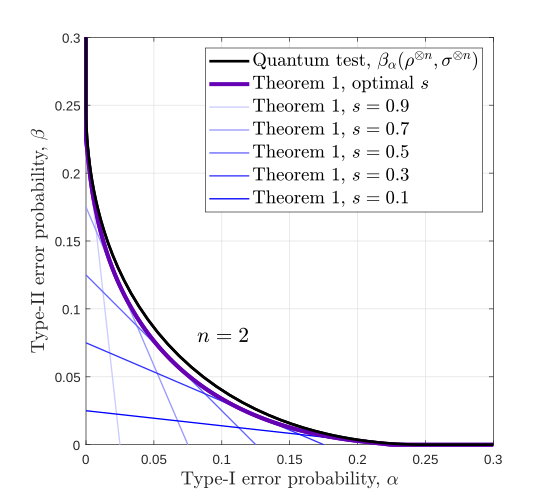
Quantum hypothesis testing plays a central role in quantum information theory, with applications ranging from communication to error correction. A key tool in its analysis is the Nussbaum–Szkoła mapping, which relates the error probability trade-off of a quantum test to that of a surrogate classical hypothesis test. This connection has been widely used in the information-theoretic literature to establish asymptotic results, including the error exponents of Bayesian and asymmetric quantum hypothesis testing (e.g., the Hoeffding bound).
In [1]-[2], we investigate the non-asymptotic gap between the error probabilities of a quantum test and its classical counterpart induced by the Nussbaum–Szkoła mapping. Building on this perspective, [2] introduces a novel lower bound for asymmetric quantum hypothesis testing derived from the same mapping. This bound provides a unified characterization across all major asymptotic regimes—small, moderate, and large deviations—while also yielding accurate approximations in the non-asymptotic (finite blocklength) setting. Unlike previous approaches based on information-spectrum methods or bounds with fixed prefactors, the proposed formulation arises from a single expression and, in some cases, enables the direct application of classical results. These results highlight how classical reductions offer both conceptual insight and powerful analytical tools for understanding quantum hypothesis testing.
Multiple quantum hypothesis testing and classical-quantum channel coding
In [3], we derive alternative exact expressions for the minimum error probability of a hypothesis test discriminating among M quantum states. The first expression corresponds to the error probability of a binary hypothesis test with certain parameters; the second involves the optimization of a given information-spectrum measure. Particularized in the setting of classical-quantum channel coding, this characterization implies the tightness of two existing converse bounds; one derived by Matthews and Wehner using hypothesis-testing, and one obtained by Hayashi and Nagaoka via an information-spectrum approach.
Generalized perfect codes for symmetric classical-quantum channels
In [4], we define a new family of codes for symmetric classical-quantum channels and establish their optimality. To this end, we extend the classical notion of generalized perfect and quasi-perfect codes to channels defined over some finite dimensional complex Hilbert output space. The resulting optimality conditions depend on the channel considered and on an auxiliary state defined on the output space of the channel. For certain N-qubit classical-quantum channels, we show that codes based on a generalization of Bell states are quasi-perfect and, therefore, they feature the smallest error probability among all codes of the same blocklength and cardinality.